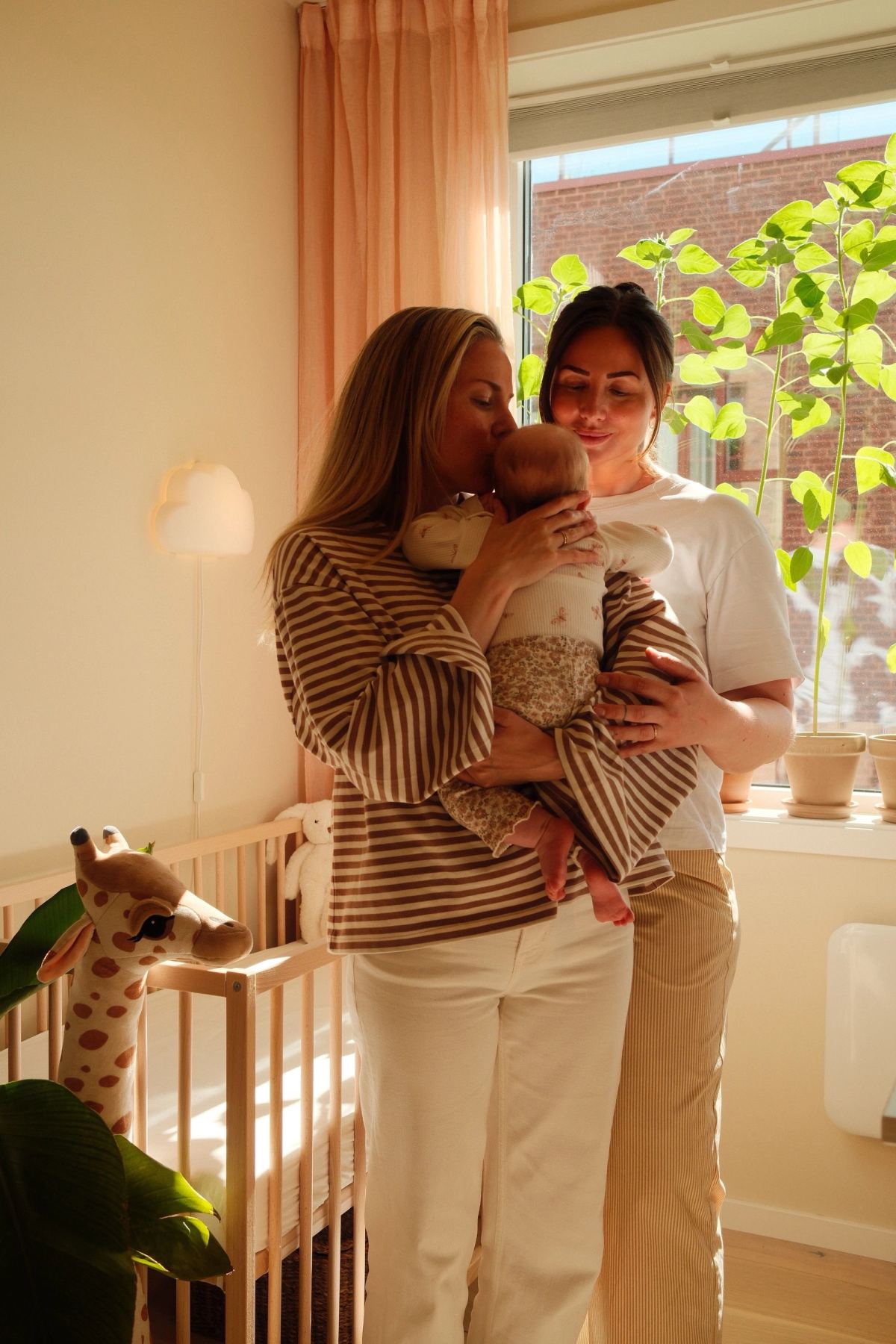

Pride 2026 · Patient story.
How we became three: meet the Bjørkvoll Rydeng family.
Maria Kathinca and Julie Bjørkvoll Rydeng knew early on that they wanted children together. What they did not know was that partner donation would give them exactly what they had dreamed of. After three attempts and one miscarriage, Emmy was born in winter 2026. This is their story.
A small grief — and a new hope
When Maria and Julie met nine years ago, they quickly knew they wanted to spend their lives together. But the more in love they became, the clearer a thought became that they had not had words for before:
– “It was almost a small grief to think that we would never be able to have a child who was half me and half Maria. The more in love we became, the stronger that instinct became — the desire to have a child together. And we did not even know that partner donation was an option,” says Julie.
Partner donation means both partners contribute biologically: one provides the egg, the other carries the child. It was not something they had planned to find out that day, but through work Julie met a same-sex couple who had done exactly this in Iceland.
– “We really got the bit between our teeth. We felt this was the right thing for us to do. Then we could make a child together — the closest we come to a child who is half me and half Julie,” says Maria.
When Norwegian law opened for partner donation without a medical reason, the decision was made. Plans to travel abroad were set aside. They would do it at home in Oslo.
There were also questions they had to ask themselves: Who would carry the pregnancy? How would it feel to carry an egg that biologically belonged to the other? Would the bond be the same?
– “There were lots of questions we did not have answers to. It is so individual. But we never doubted that this was what we wanted,” says Maria.
To be seen, not only treated
The couple started the process at another clinic, but felt they were not followed up well enough and that the chemistry was not right. They therefore chose to change clinic and continue the process at CMedical.
– “We have encountered attitudes that partner donation is tampering with biology. At CMedical we were welcomed with open arms and an open mind, and felt completely at home,” says Julie.
For Maria this had an extra dimension. She herself is a donor-conceived child — from a time when anonymous donors were the norm, and when children did not have a legal right to know their biological background. Not knowing for many years where you come from has been part of her own story, and as an adult she has run an association for others in the same situation.
– “I have lived this life myself. That is why it was important for us to choose a donor who was similar to us in personality, and also Scandinavian, to make it easier for Emmy if she one day wants to make contact. And we have reserved enough straws so that any siblings have the same donor — because we want to give all our children the same starting point, if they one day want to contact their donor.”
At CMedical they were followed up by nurse Jeanette Follestad and doctor and gynaecologist Birgitte Mitlid-Mork. Both quickly became important support people in the process.
– “Being treated by someone who understands, who meets you with respect and understanding on equal terms with everyone else — that means everything. Jeanette and Birgitte have been fantastic. We were taken such good care of,” says Maria.
The assessment showed that both were in a similar position. The choice of who would carry first naturally fell on Julie, since Maria had recently started a new job and felt the timing was not right for parental leave. Maria’s eggs were therefore retrieved, and together with the treating doctor and nurse, donor characteristics were chosen from a European sperm bank.
The grief, the uncertainty — and the third attempt
The first attempt was in December 2024. Julie became pregnant — on the very first try.
– “We were over the moon. It was completely fantastic. I was walking on air,” says Maria.
But in week 7 bleeding started. They contacted Birgitte, who stayed open at the end of a Friday so the couple would not have to go into the weekend without answers. There they had confirmed what they feared: a miscarriage.
– “We went home and grieved on the sofa. It was tough. But we gave each other time, and then we tried again,” says Julie.
The second attempt in March 2025 did not implant. Both felt it was becoming heavy — physically and emotionally.
– “You really feel that you are not in control. You are used to having control in so many areas of life, and then it is just the body that decides. It was demanding to live with,” says Maria.
Julie works on a neonatal intensive care unit — a job that is demanding both physically and mentally. Standing in a fertility process at the same time began to take its toll.
Between the second and third attempts they went on holiday to New York — and came home with their shoulders a little lower. When they started the third attempt, it was decided together with Birgitte that Julie should go on sick leave.
– “Birgitte had said that on average it takes three attempts. That was exactly right for us. The third attempt, in May 2025, was the one that finally took,” says Julie.
They took early pregnancy tests day by day and saw the line become clearer and clearer, until there was no longer any doubt that it was a pregnancy. Even so, they waited a good while before announcing the pregnancy to those around them, for fear that something would go wrong again.
Emmy — born on grandfather’s birthday
Emmy had a due date on Valentine’s Day, but arrived two weeks early, in 2026. Julie gave birth at Ullevål — where she herself has worked for eight years. Maria was present throughout the birth.
– “It was a powerful experience to take part in. Seeing Julie master the birth with such calm was incredible to witness. I got to lift Emmy up and lay her on Julie’s chest the moment she was born, and I also got to cut the umbilical cord,” says Maria.
When Maria sent a message to her parents with the news, her father replied: she was born on grandfather’s birthday. The last piece fell into place.
– “Then it was obviously clear. She had to be called Emmy after my paternal grandmother,” says Maria.
For Maria the name had extra meaning. As a donor-conceived child, she found out as an adult that the father she had grown up with was not her biological father. It was a tough message to receive, but it also made the bond between them even stronger.
– “He is my dad, and one of my greatest role models. And that Emmy was born exactly on grandfather’s birthday and received a name from the paternal side was very moving and meaningful. We already had the name ‘Emmy’ on the list, but when she was born on this date it suddenly felt completely right that she should be called that,” she says.
Today Emmy is four months old, has just learned to roll, and smiles a lot.
– “We love life with Emmy, and cannot understand what life was before her,” says Julie.
Advice to others considering the same
Maria and Julie are clear that partner donation was right for them, but that there are many paths to becoming a parent, and you have to do what feels right for you.
– “Do your research and look into the options. What we chose does not have to be right for everyone. Listen to your gut, and to what feels right for you,” says Julie.
Maria particularly wants to emphasise one thing:
– “Find a place where you feel seen. That was the most important thing for us. A place where every question and worry is met with calm and respect, without you having to explain who you are or apologise for anything. That means everything,” she says.
Emmy is four months old and lives in Oslo with her two mothers. Maria Kathinca and Julie Bjørkvoll Rydeng share their story in the hope that it can inspire others considering assisted reproduction.